Where to stay in Rovaniemi: the five areas, their prices and their constraints
The last bus from Santa Claus Village back into town leaves at 19:35. That single fact decides where you sleep, ahead of the price and ahead of the photos. The five areas compared, season by season.
Most guides rank Rovaniemi's accommodation by rating and by budget. That is the wrong order: here, the address decides first of all what you will be able to do with your days and your evenings.
The reason fits on one line of a timetable. The last bus from the Arctic Circle back into town leaves at 19 h 35 on weekdays and 18 h 05 at weekends, and Santa Claus Village is about 8 km out.
Put another way, a badly placed room is paid for twice: once at booking, then again in taxis every evening. We proved it with the numbers in our guide to getting around Rovaniemi, which this page is built on.
So this page takes the areas first, with what each one costs and what each one forces on you. Then the price bands by category and by season. Then the sauna question, genuinely included or quietly charged depending on the property.
Why does the address matter more than the star rating?
Rovaniemi is not a big city. Its about 66,000 inhabitants fit around a centre you can walk across in a quarter of an hour, with the restaurants, the museums and the activity agencies grouped along a few streets.
Everything else, Santa Claus Village included, is reached by bus, by shuttle or by taxi. The bus costs €3.60 and takes 15 to 25 minutes, the taxi 20 to 32 € per car.
The problem is not the distance, it is the timetable. First departures are around 05:50 on weekdays, around 11:15 at weekends, the last returns come in the early evening, and there is no late service and no night service at all.
Dinner in town from the village therefore ends in a taxi, unless you leave the table at 7pm. Three evenings like that, and everything you saved on the room has gone.
The five areas of Rovaniemi in one table
Here is the useful geography, the part missing from most booking listings. The distances come from the 2024 to 2026 measurements cited at the foot of this page.
| Area | To the centre | To Santa Claus Village | What you sleep in | What it forces on you |
|---|---|---|---|---|
| Town centre | on the spot | about 8 km | chain hotels, hostels, city flats | nothing, everything is done on foot |
| Around the railway station | a 10 to 20 minute walk | about 8 km | guesthouses, small inns, flats with parking | a 10 to 20 minute walk every time you go out |
| Ounasvaara | 3 km, about 5 minutes by taxi | 8,5 à 9 km | chalets, resort hotels, cabins with a view | a taxi for every dinner in town |
| Santa Claus Village | about 8 km | on the spot | family cabin villages, igloos, glass-roofed suites | the last bus at 19 h 35 |
| Outskirts and lodges | up to 27 à 30 km | varies | resorts, igloo villages, farms, private houses | a car, or the lodge's own transfers |
Hold on to that last row: some places sold as being "in Rovaniemi" are half an hour's drive from the centre. We come back to it in detail below, it is the costliest trap in the destination.
The town centre, the default choice, and rightly so
It is the most versatile area, and for a first stay it is almost always the right call. Shops, restaurants, bars, activity agencies and the bus station all sit within a few hundred metres of each other.
More to the point, this is where route 8, the shuttles and most excursion pick-ups start from. In Rovaniemi the activity comes to fetch you: you simply have to be on its route.
On price, expect 130 à 250 € for a 3 to 4 star double room in winter, and 290 à 500 € for a luxury boutique. The plainer chain offering sits lower.
Around the station, the clever budget option
The railway station sits on the edge of the centre, a 10 to 20 minute walk away depending on the address. The mood is functional, more transit than holiday: car parks, a few guesthouses, little charm.
That is exactly what makes it interesting. Rates here are often below the heart of the centre, with family guesthouses recorded at 42 à 43 € a night outside high season in 2025.
The area earns its place above all if you arrive on the night train from Helsinki, or if you are hiring a car: parking is simpler here than in the paid central zone.
Ounasvaara, the forest five minutes away by taxi
Ounasvaara is the wooded hill south-east of the centre, known for its skiing, its trails and its view over the town. It is 3 km from the centre, about 5 minutes by taxi.
The feel is mountain resort rather than urban: forest, dimly lit roads, chalets at the edge of the piste, large communal spaces and often a proper hotel sauna.
The trade-off is clear. Buses thin out in the evening, independent restaurants are scarce, and you will usually eat where you sleep. Budget for a return taxi for every night out in town.
It is the right area if you are here to ski, to walk or simply to be somewhere quiet, and if you accept dining at the hotel several evenings running.
Santa Claus Village, the immersion and what it costs
The village is about 8 km from the centre, on the line of the Arctic Circle. It is an entirely touristic enclave: shops, Santa's offices, themed restaurants, activities for children.
You will find family-focused cabin villages, igloos and glass-roofed suites. Buses shuttle back and forth roughly every 30 minutes in high season, in the daytime only.
The premium is real and documented: for comparable quality, the village area lists at 130 à 850 € against 80 à 300 € in town, so 20 to 30% more on the usual items.
What actually happens on site, free and paid, is covered in our guide to Santa Claus Village. Whether you should sleep there is settled further down this page.
The outskirts and the remote lodges
Two very different realities hide behind that one word. There are the suburbs of Rovaniemi, served by the local buses, and there are the genuinely remote lodges, thirty kilometres from anything.
The documented example is Arctic SnowHotel & Glass Igloos, at Sinettä, 27 à 30 km from the centre, about a 30 minute drive. The municipality really is Rovaniemi. So is the open countryside.
These addresses have one objective advantage: the night is properly dark, with no light pollution, which counts if you want to watch the northern lights. They work as packages, with meals, activities and transfers included.
The drawback is just as clear: without a car, dinner in town or a museum visit turns into an expedition. Check before booking whether the activity shuttles call at the lodge or expect you at a meeting point in town.
One in-between case worth knowing: the strip along the airport and the Arctic Circle road, 2 à 3 km from the runway. It holds resorts and igloos aimed at Santa and the aurora, close to the village, far from the restaurants in town.
Available places to stay, with their prices. Stay22 compares the booking platforms.
Partner map: booking through it supports the site at no extra cost to you.
How much does a night in Rovaniemi cost, category by category?
Here are the orders of magnitude recorded for 2026, in euros per night and per room. They cross-check several specialist price guides, as no single official scale exists for the town.
| Category | Off season, June to September | Winter outside December | December |
|---|---|---|---|
| Hostel, dorm bed or very basic | 30 à 75 € | 35 à 90 € | 60 à 120 € |
| Budget hotel | 80 à 130 € | 100 à 160 € | 160 à 250 € |
| Three star hotel | 110 à 200 € | 140 à 240 € | 250 à 350 € |
| Upper tier hotel or resort | 180 à 280 € | 220 à 350 € | 350 à 500 € |
| Standard cabin or chalet | 55 à 120 € | 80 à 160 € | 150 à 300 € |
| Self-catering flat | 90 à 180 € | 110 à 220 € | 200 à 350 € |
| Glass igloo | 250 à 450 € | 300 à 850 € | 400 à 990 € |
Two things stand out. The first: between the hostel and the igloo the ratio is one to ten in December, for the same sky and the same activities the following morning.
The second: the cabin is the only line where you gain space while paying less than a hotel room. For a family or a group, it is the most profitable trade-off on the list.
Outside the winter season the whole grid deflates sharply. A decent hotel goes for 80 à 150 € a night in April or October, the two most affordable months of the year in Rovaniemi.
The budget tier, what you actually get
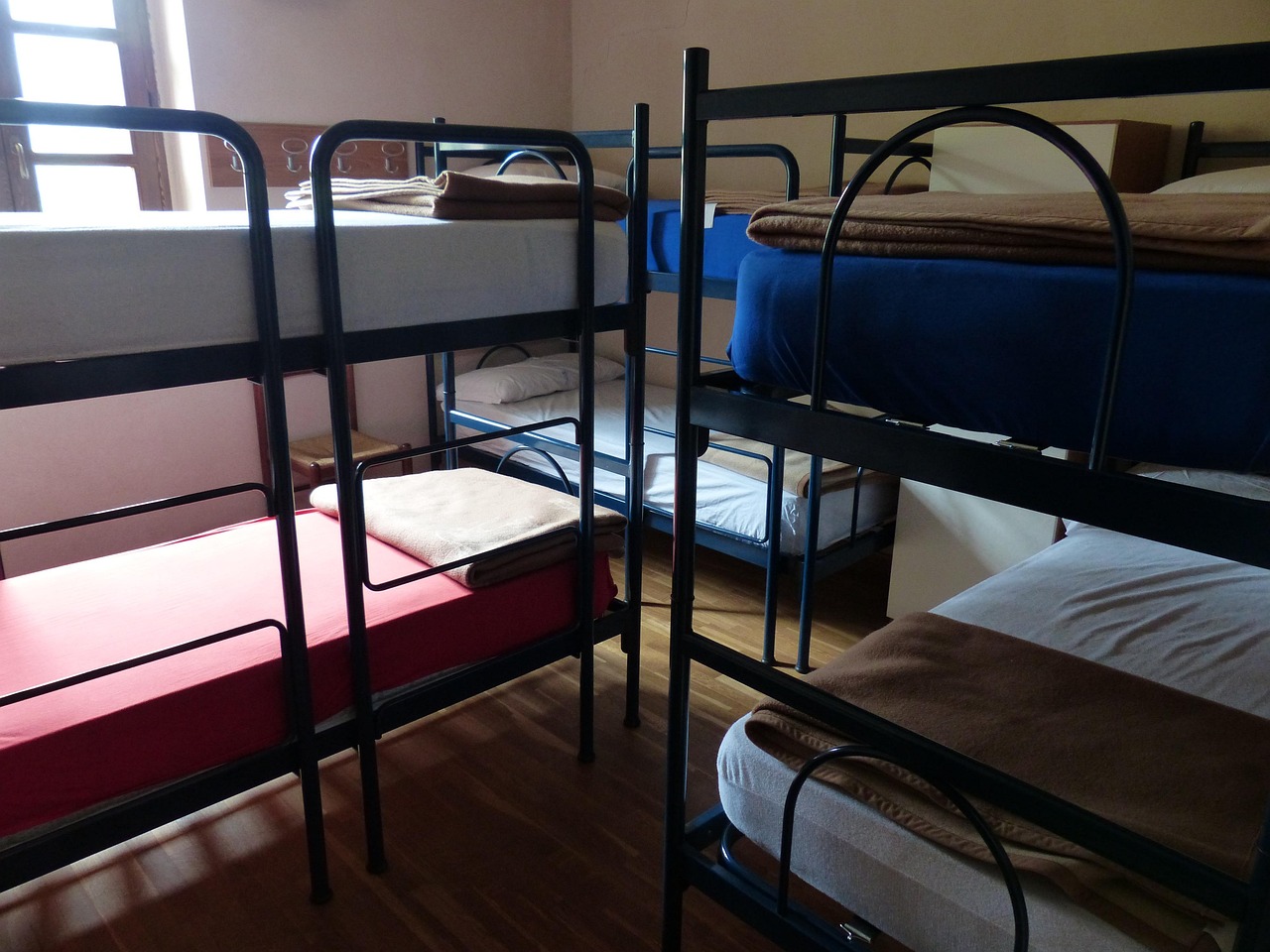
A dorm bed goes for 25 à 40 € a night, a private room in a hostel for 50 à 80 €. These places cluster in the centre and near the station.
For a benchmark, a well-known central address lists 29 € for a dorm bed, 69 € for a private twin with breakfast and 119 € for a family room, 2026 lead-in rates.
Rovaniemi's hostels have one quality its hotels do not: their prices move far less across the year. The pressure is on availability, not on the rate.
The cabin tier, the best space for your money
Budget cabins sit at 55 à 120 € a night, mid-range ones at 150 à 310 €, and luxury cabins with big picture windows at 300 à 600 €.
The kitchen that comes with them changes the whole trip budget, in a town where dinner out easily runs to 30 to 50 € a head. Over four nights for four people, the gap is considerable.
The igloo tier, and why Rovaniemi is the cheapest
A glass igloo costs 300 à 850 € a night in an ordinary winter and up to 400 à 990 € in December. It is the most volatile line in the destination.
One point rarely written down: the igloos around Rovaniemi are on average €100 to €200 cheaper per night than those at Saariselkä or Inari, for comparable quality.
If the igloo is your priority, compare the packages before you block out a night: our dedicated guide to sleeping in a glass igloo sets out what you really pay for, glass roof included.
What does Christmas week really do to the prices?
The word "increase" is too weak. Across the window running from 20 December to 2 January, accommodation in Rovaniemi applies a multiplier of environ 2,5 against March rates.
In practice, a €150 room in March becomes about €375. Mid-range hotels charging €130 to €180 in an ordinary winter end up at 300 à 420 €.
The clearest example comes from Santa Claus Village itself. A standard cabin there was priced at 335 € in late November, 405 € over the holidays, then 189 € from January to the end of March.
Same cabin, same village, same snow: the price falls by more than half between 7 and 8 January. It is the clearest possible proof that you are paying for a date, not for a service.
At the top end the gap becomes vertiginous. The igloo resort at Sinettä goes from €314 in low season to environ 1 500 € for Christmas and New Year.
The conclusion fits in one sentence: if your calendar has any flexibility at all, moving by two weeks beats dropping a category. Our page on which month to choose lays out the full trade-off, snow and daylight included.
How far ahead should you book?
Recommended lead times vary enormously by type of accommodation. Here is what the specialist guides repeat for 2026, and it matches what we see on the ground.
| Type of accommodation | Recommended lead time |
|---|---|
| Hostel, for December | 1 to 2 months ahead |
| Standard hotel, January to March | 3 to 4 months ahead |
| Cabin or chalet, snow season | 2 to 4 months ahead |
| Glass igloo, high season | at least 6 months ahead |
| Christmas week, all categories | 10 to 12 months ahead |
| March and the shoulder season | a few weeks to 2 months |
What locks up first is always the same: the igloos, the themed cabins at Santa Claus Village, then the best-known central hotels over the school holidays.
For an igloo at Christmas, the lead time climbs to 8 to 12 months ahead at most properties, and some are full by the previous spring.
Is the sauna really included?
It is the most misunderstood promise in the whole destination. "Sauna" on a hotel listing does not mean a private sauna in your room, and it does not always mean free.
Here is the reality by category, as the 2026 guides describe it. It is worth reading before you pay a supplement for a room "with sauna".
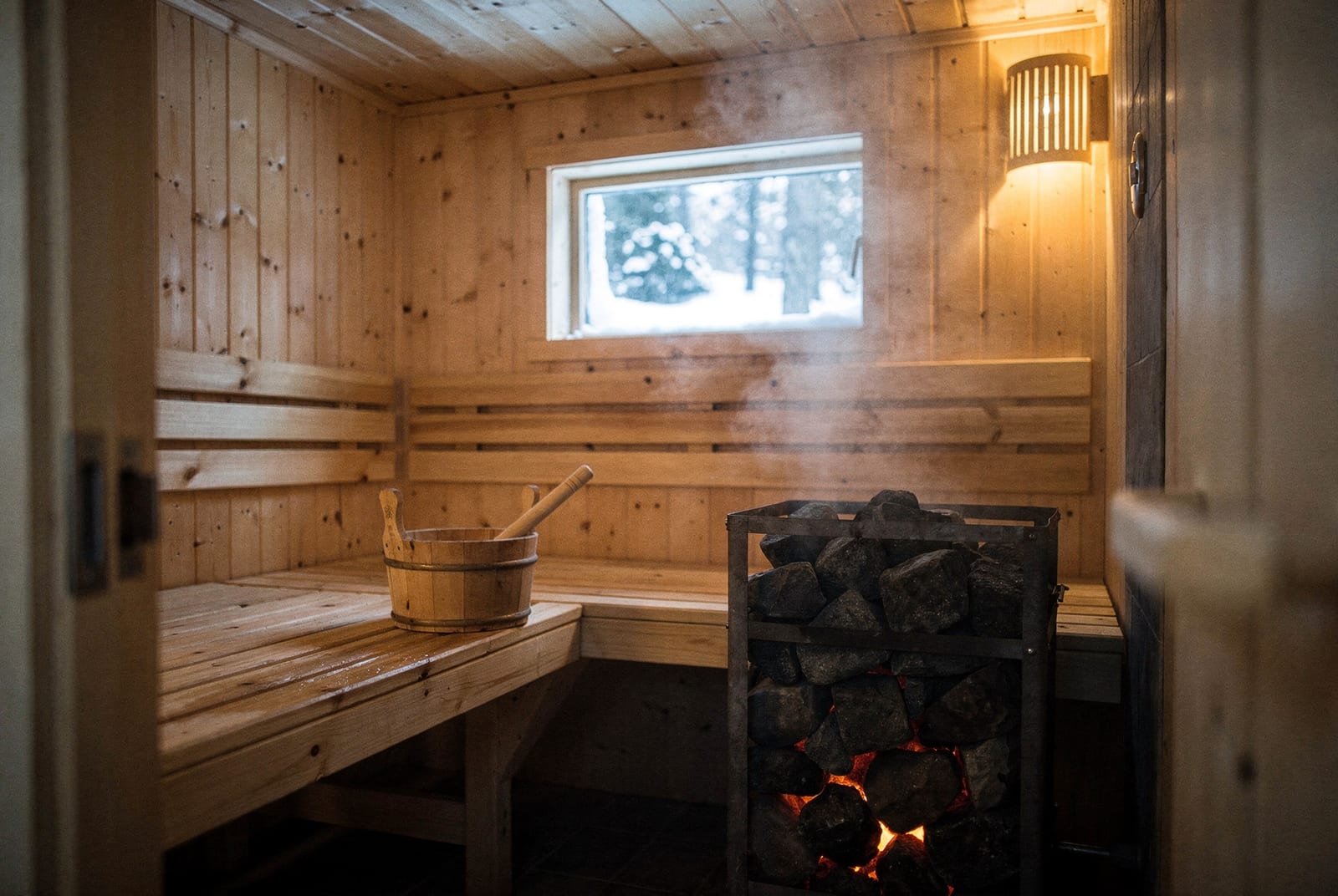
- Hostels: a shared sauna in the building, very common, usually included in the nightly rate, with separate or mixed slots depending on the property.
- Budget and mid-range hotels: a communal guest sauna is fairly standard, sometimes limited to certain time slots. Included in most cases, though some hotels charge a supplement.
- Upper tier hotels and resorts: a communal sauna, plus the option of a private sauna in the room or the cabin. Booking a spa area privately, on the other hand, is almost always a paid extra.
- Budget cabins and chalets: this is the little-known bargain. Most cabins at 55 à 120 € a night have a kitchen and a sauna, both included.
- Flats: highly variable. Some modern Finnish homes have a small domestic sauna, many do not. No aggregate figures exist, so it has to be checked property by property.
The rule to remember is simple: never assume private. In most cases the sauna at your accommodation is communal, and private use is either included with a cabin or sold as an extra.
If your trip hinges on the sauna and ice swimming experience more than on where you sleep, booking a dedicated session works out cheaper. Our guide to sauna and ice swimming compares the public and private venues in town.
Three traps that cost money
A place listed "in Rovaniemi" can be 30 km out
The municipality of Rovaniemi is enormous, larger than plenty of English counties. A resort 27 à 30 km from the centre is legally in Rovaniemi, and says so on every listing it appears on.
This is not a lie, it is a trap of perception. To a British reader, "Rovaniemi" suggests a town centre: the map sometimes shows thirty minutes of country road instead.
The reflex that solves it takes a minute. Before booking, open the map and measure the real distance to Koskikatu, the main street, not to "Rovaniemi".
The extra charges on self-catering lets
On flats and on some cabins, the nightly price shown is not the price paid. Final cleaning, bed linen, sometimes wood for the sauna or the fireplace, are all billed separately.
No reliable average exists for these charges, and that is precisely the problem: they run from €0 to over €100 depending on the operator, with no visible logic.
On a two-night stay, a hundred euros of cleaning turns a €120 cabin into a €170 one. Always open the "additional fees" section before you confirm.
Photos show neither the crowding nor the real aurora odds
Two visual deceptions come up again and again. Igloos are photographed under a permanent aurora, when the real probability is far lower, and cabins look isolated when in fact they stand in tight rows.
No source publishes a verified list of the properties concerned, so this is a general warning and not an accusation. But it holds for almost the whole signature segment.
The defence is to look for travellers' photos rather than the property's own, and to read our guide to the northern lights for the real odds before paying for a glass-roofed room.
Santa Claus Village or the town centre: how do you decide?
It is the question everyone asks, and it deserves a firm answer rather than an "it depends". Here is ours, after lining up the distances, the timetables and the prices.
Sleep at Santa Claus Village if:
- you are travelling with young children and the point of the trip is the Santa experience, the reindeer and the workshops, without piling up journeys;
- your stay is short, two or three nights, and built around the activities in the village;
- you think in terms of an experience budget rather than a nightly rate, and accept 20 to 30% more to sleep next to the attractions;
- you are travelling without a car and have no intention of going out in the evening: everything is organised around you during the day.
Sleep in town if:
- you want to experience Rovaniemi as a town, with its restaurants, its museums and its bars, rather than as a theme park;
- your stay runs beyond four or five nights: the Christmas universe palls quickly, and the evenings lack variety;
- your budget is tight, as town is markedly cheaper for equal comfort, 80 à 300 € against 130 à 850 €;
- you want to stack up varied activities: nearly all of them leave from the centre, and many collect you at your hotel.
And if the northern lights are your priority, neither one wins. The lodges on the outskirts, at Ounasvaara or at Sinettä, give you a darker night, packages built for it, and a sky the village lighting spoils.
One last figure to settle it honestly. The village takes visitors every day who do not sleep there: route 8 runs all day for €3.60. Sleeping on site buys you an easy morning, not access.
Compare the distances before the ratings: the one thing a booking engine shows badly is exactly what this page has just demonstrated, the real distance to the centre and the time of the last bus. Open the map, then compare on identical dates accommodation in Rovaniemi and where it actually sits in the town and accommodation at Santa Claus Village. The gap becomes readable in thirty seconds.
See places to stay in Rovaniemi →Affiliate links: booking through them supports the site at no extra cost to you.Three travellers, three logical addresses
A couple, four nights in February, northern lights in mind. A hotel in the centre at 130 à 250 € a night, plus one or two guided aurora outings. The evenings stay free, and the total budget stays under control.
A family of four, five nights in December. A cabin with a kitchen and a sauna at 150 à 300 € a night in December, rather than a cramped hotel room. How to organise it is covered in our guide to Lapland with children.
Tight budget, three nights in March. A hostel in the centre at 25 à 40 € a bed, with a communal sauna usually included, and a bus ticket when you need to go up to the village. Accommodation drops below a hundred euros for the whole stay.
To add all of that up with the flights, the activities and the meals, our estimate of what a trip to Lapland costs goes through every line.
What we could not verify
Several points remain unclear, and we would rather write that than publish an invented average.
- There is no official scale of hotel prices in Rovaniemi. Every band on this page is a synthesis of 2024 to 2026 price guides, not an exhaustive survey.
- Cleaning and linen charges are covered by no aggregate statistics. Only the wide range is documented.
- Finland applies no national tourist tax and no source reports a notable municipal tax in Rovaniemi. Some properties may still charge local fees, with no standard published amount.
- Price comparison sites name February as the most expensive month and April as the cheapest, but publish their averages in Indian rupees on baskets they never detail. We quote the trend, not the amounts.
- The exact proportion of hotels charging extra for the sauna is quantified nowhere. The guides flag the practice, never the figure.
- No single last-bus time is published on the village side for a whole season: we use the route 8 times recorded for 2026-2027.
Sources
rovaniemi.tours, Travel costs explained and the Ice hotels & glass igloos in Lapland guide, 2026 editions, for the general price bands and the Sinettä rates. laplandtripplanner.com, Where to stay in Lapland and Best hotels Rovaniemi, 2026 editions, for the bands by category, the Christmas multiplier and the booking lead times.
hostelcafekoti.fi for the hostel rates displayed in 2026, Destinia for the station area guesthouses recorded in 2025, finlandholidays.travel for the Santa Claus Village cabin rates over the 2023-2024 season, glass-igloos.com for the price gap between Rovaniemi and Saariselkä.
Rome2rio for the Ounasvaara and Santa Claus Village distances, santaclausvillage.info and rovaniemitours.com for the village bus service, frugalmum.co.uk for the car-free field report. Route 8 times recorded from Linkkari and Visit Rovaniemi, 2026-2027 season. Data checked in September 2026.
Frequently asked questions
Where should you stay in Rovaniemi without a car?
Should you sleep at Santa Claus Village?
How much does a hotel night in Rovaniemi cost in December?
How far ahead should you book accommodation in Rovaniemi?
Is the sauna included in Rovaniemi hotels?
Is a property advertised as being in Rovaniemi close to the centre?
Which is the cheapest month to stay in Rovaniemi?
Erik Lindqvist
Based in Rovaniemi, Erik knows the difference between a working reindeer farm and a show staged for coach parties. He writes from the ground, not from a press release.