Lapland webcams live: Santa Claus Village, Levi and the aurora cameras
The live feeds from Santa Claus Village, Levi and four aurora cameras, playable on this page, with the operator behind each one, its broadcasting season and how to read the picture without fooling yourself.
Here are the live webcams of Finnish Lapland, playable without leaving this page: Santa Claus Village, the Levi slopes and four aurora cameras.
Each player follows its operator's own channel, so the picture stays valid even when the broadcast moves to a new video.
Operated by Ville de Rovaniemi
Operated by Visit Rovaniemi
« Levi Six chairlift | Levi Ski Resort | Finland » · Operated by Levi Ski Resort
A camera with no player above is not broadcasting right now: it is not broken, it is waiting for night or for the season. This page checks each channel when it loads.
Those three feeds run all year, by day and by night, polar night included. The aurora cameras only broadcast after dark, and not in summer.
Where can you watch the northern lights live?
Four cameras film the northern Finnish sky, from Levi up to Utsjoki. They do not show the same thing at every latitude: the further north, the more often the aurora appears, and the lower it sits on the horizon.
« Northern Light Live Kilpisjärvi, Finland. North view » · Operated by Starlapland · Broadcasts late August to early April, at night
« LIVE 24/7 Northern Lights & Sky Cam | Lapland Finland Webcam | Aurora Borealis from Posio » · Operated by Hotel Lapin Satu · Broadcasts late August to early April, at night
« LIVE northern lights camera from Utsjoki in Finnish Lapland » · Operated by Aurora Holidays · Broadcasts late August to early April, at night
Operated by Aurora Borealis (LIVE!) · Broadcasts late August to early April, at night
A camera with no player above is not broadcasting right now: it is not broken, it is waiting for night or for the season. This page checks each channel when it loads.
One caveat before you trust these pictures, and it changes everything: what the camera displays is not what you would see standing there. The next section explains why.
Why can a webcam show the northern lights when you see nothing outside?
An aurora camera is not an eye. It collects light over an exposure lasting several seconds, whereas the retina works in real time and accumulates nothing at all.
Typical settings on these cameras run from around one second to about thirty seconds of exposure, with high sensor gain. No public page documents the exact settings used in Lapland: that is a working order of magnitude, not a measurement.
The result is mechanical. Long exposure lifts overall brightness, saturates the greens and the purples, and smooths out movement: a faint but wide display turns into a cleanly drawn curtain on screen.
Then there is human night vision, known as scotopic vision, which reads contrast very well and colour very badly. That is exactly the gap set out on our page about seeing the northern lights in Lapland, between the photograph and what the eye actually registers.
Local forecasting services ended up formalising that gap in three levels: nothing, visible to the sensor, visible to the naked eye. The numbers fit on one line, Kp 2 is enough for a camera, the naked eye needs Kp 3.
So there is a whole category of nights where the webcam is perfectly right and you would have seen nothing. Heading out at -20°C on the strength of a green image is a gamble, not an informed decision.
One last factor, often forgotten: the camera is nearly always sited away from the street lights, sometimes on high ground. You, standing in the middle of the village with public lighting behind you, structurally see less than it does.
How do you read a northern lights webcam properly?
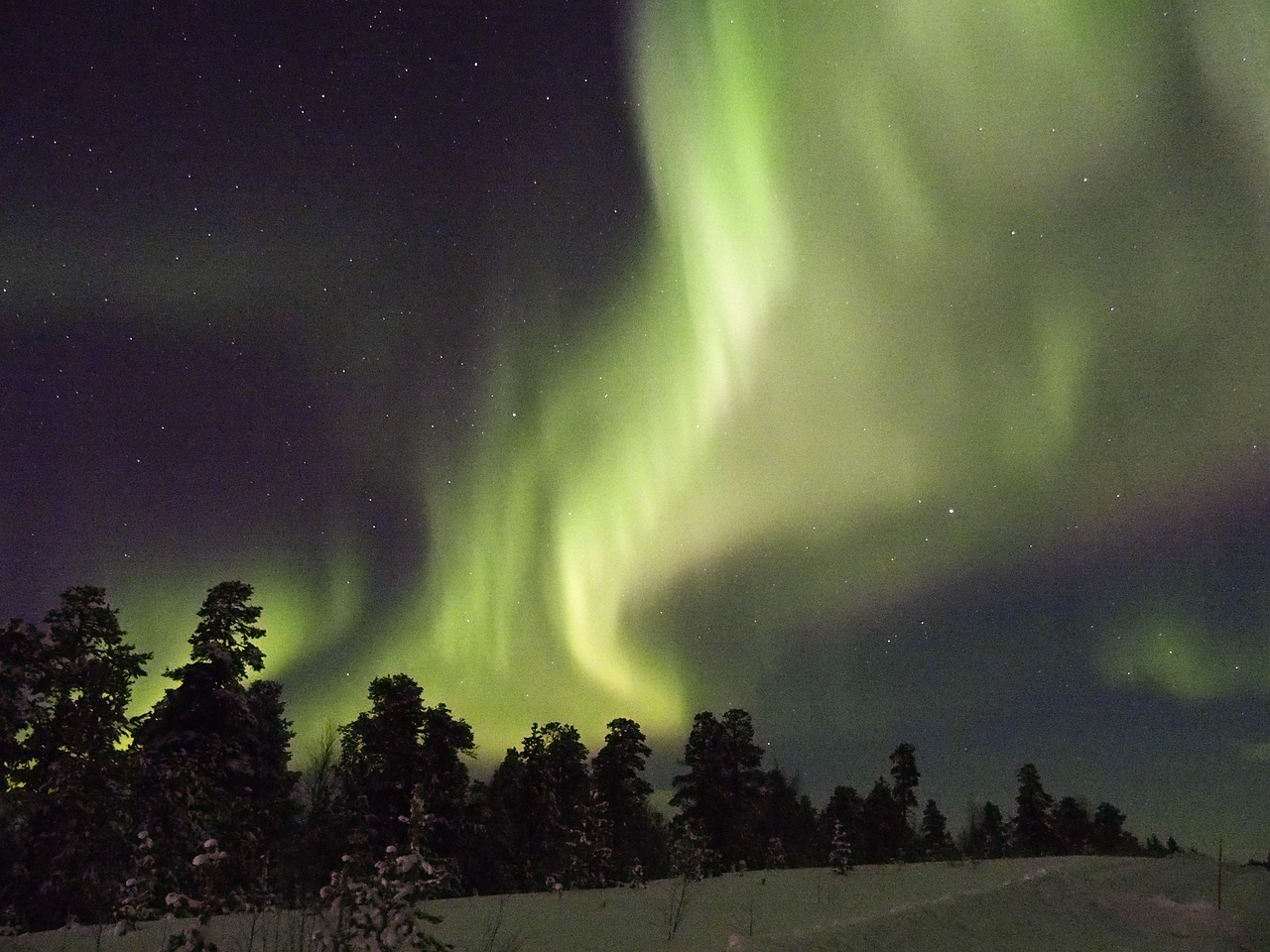
The right approach is to treat it as a weather sensor, not as a promise of a show. What it reliably establishes is the state of the sky: clear, hazy or completely closed in.
That is no small thing, because cloud cover is the number one limiting factor at this latitude. It runs from 68% in March, the clearest month, to 86% in December.
Two readings follow. Sharp, bright arcs on screen point to a display probably visible to the naked eye; a faint veil guarantees nothing, since it may exist only thanks to the long exposure.
The useful habit is to cross-check several cameras that sit well apart from each other. A clear sky on three feeds tens of kilometres apart is worth more than one fine image from a single point.
The webcam sees it, you may not: a sensitive camera captures displays the naked eye cannot make out, and it is placed where the sky is dark, not where you are sleeping. That is exactly what the northern lights tours leaving from Rovaniemi put right: they track cloud cover live and take you under the gap, instead of leaving you to guess in front of a screen.
See the northern lights tours →Affiliate links: booking through them supports the site at no extra cost to you.Live stream or refreshed still: how do you tell them apart?
Both exist side by side, and nothing on screen reliably says which is which. The Santa Claus Village webcams are genuine video streams, hosted on the City of Rovaniemi YouTube channel and broadcast continuously.
The Levi cameras are also announced as video streams by the resort and by the ski portals. But the aggregator SnowStash relays the same locations as still images, refreshed every 10 minutes in 2025.
The contradiction is not really one. Each platform relays the feed in its own way: the same camera can be live on the official site and a ten-minute-old photograph on an aggregator.
None of the sources consulted gives a latency figure or a frame rate. So we can tell a live stream from a still image, but not measure the real delay, which runs from a few seconds to a few tens of seconds on consumer streaming.
The practical test takes thirty seconds. Fix on something that moves in the frame, a flag, a gondola cabin, a passer-by: if it does not shift by a single pixel, you are looking at a photograph.
Which other webcams exist in Lapland?
Two areas are genuinely covered and documented: Rovaniemi and the Levi resort. The city of Rovaniemi lists five public cameras on its international portal, while Levi and the ski portals between them count eight.
| Location | Operator | Stated type | Update |
|---|---|---|---|
| Santa Claus Village, main square | City of Rovaniemi | Live video via YouTube | Continuous stream |
| Santa Claus Office | City of Rovaniemi and Santa Claus Village | Live video | Continuous stream |
| Ounasvaara 360, Rovaniemi | City of Rovaniemi | 360° panorama | Not stated |
| Lordi Square, town centre | City of Rovaniemi | Live video | Not stated |
| Koivusaari 360, riverside | City of Rovaniemi | 360° panorama | Not stated |
| Levi, Zero Point | Levi Ski Resort and Visit Levi | Video stream announced | Continuous, or a still depending on the portal |
| Levi, South Point | Levi Ski Resort and Visit Levi | Video stream announced | Continuous, or a still depending on the portal |
| Levi Village | Levi Ski Resort and Visit Levi | Video stream announced | Continuous, or a still every 10 min on SnowStash |
| Levi, Glacier Express | Levi Ski Resort and Visit Levi | Video stream announced | Continuous, or a still depending on the portal |
| Levi, Gondoli (gondola lift) | Levi Ski Resort and Visit Levi | Video stream announced | Continuous |
| Levi, chairlift 6 | Levi Ski Resort and Visit Levi | Video stream announced | Continuous |
| Levi, golf course | Levi Ski Resort and Visit Levi | Video stream announced | Not stated, useful outside the ski season |
| Levi, Tuikku 360 (450 m) | Levi Ski Resort and Visit Levi | 360° panorama | Not stated |
This table reflects what the operators and the aggregators state between 2024 and 2026. It does not certify that a given camera is working today, and that is precisely the next point.
The players on this page do not point at one particular video but at the operator's channel. That is deliberate: a restart creates a new video and the old one becomes a dead stream, with nothing on screen to say so.
How do you tell whether a Lapland webcam is still alive?
It is the question webcam directories never touch, even though these feeds go down regularly with nothing to flag it. A page can stay online for years after the camera itself has stopped.
- A frozen image: no change in the light, no shadow moving round, no snow shifting, over several hours in a row.
- A timestamp that does not match local Finnish time, which is two hours ahead of the UK.
- An error message along the lines of "camera offline" or "temporarily unavailable", sometimes hidden behind an archive image.
- The camera disappearing from the official lists, while a blog or an aggregator carries on displaying it.
The best filter is still the source. A camera listed on the City of Rovaniemi portal or on the Levi Ski Resort site stands a good chance of being maintained; the same one relayed by a third-party aggregator may be nothing but a leftover.
It needs saying plainly: none of the sources consulted lists an out-of-service webcam in Lapland, nor publishes a failure rate. The four signs above come from how webcam portals work in general, not from a local survey.
What can a webcam actually help you decide?
Three uses stand up, and only one of them concerns the northern lights. Here they are in decreasing order of reliability.
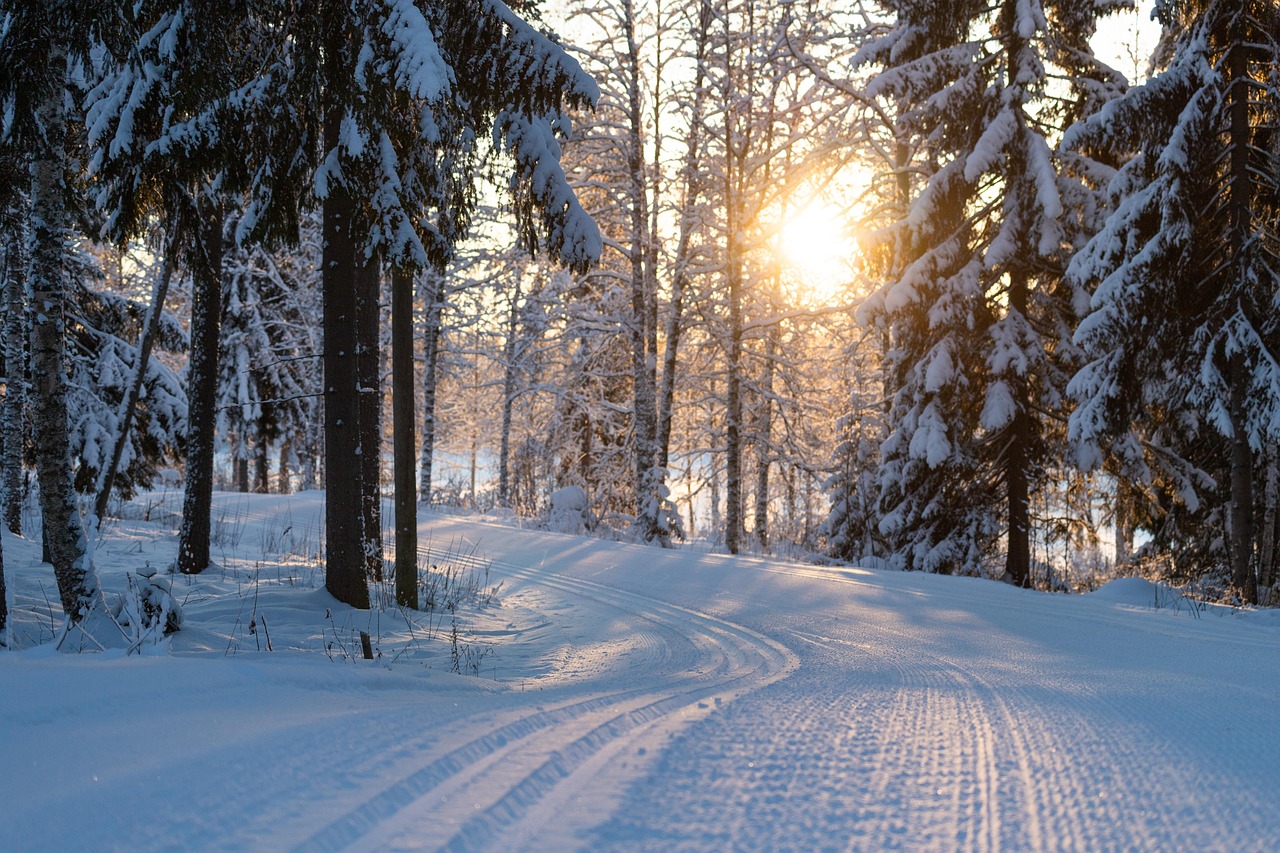
Checking the snow before you travel. This is the soundest use of all. An image shows the apparent depth of the cover, the ice patches, the bare ground, and whether the lifts are turning.
It does not give you centimetres, and that is exactly where it complements the averages. Mean maximum depth goes from 41 cm in December to 84 cm in March, but any given year can depart from that considerably.
Watching a camera ten days before departure answers the only question that matters: is the snow there, this year, right now. The seasonal detail is in our guide to choosing which month to travel.
Gauging how busy the village is. The Santa Claus Village feeds show how dense the main square is and whether the coaches have arrived. The indicator is qualitative, quiet, moderate or packed, but it reads in five seconds.
The clever move is to check the camera in the morning, from the town centre, 8 km away. In December, the queue to meet Santa reaches 60 to 90 minutes at the worst times.
Seeing the square empty at 9am and heaving at 1pm does not change your programme, it changes the time of your bus. Opening hours and queues are set out on our page about the Santa Claus Village.
Reading the evening cloud cover. A live camera tells you at 9pm what no forecast says with the same precision: whether there is a gap in the cloud above one specific point on the map.
Cross-check two or three distant cameras against the local forecast before you get dressed. The chance of seeing the northern lights on any given night runs from 4.5% in December to 10% in March.
The window to watch is still from 10 pm to 2 am. Once the gap is spotted you still have to reach it, and the choice of site weighs as much as the sky: see where to watch the northern lights in Rovaniemi.
Can you embed a Lapland webcam on your own site?
The question comes up as soon as you want to show a live feed somewhere other than its original page. The honest answer is: it depends on the operator, and the paperwork is missing.
The Rovaniemi and Santa Claus Village feeds are hosted on YouTube. Embedding therefore goes through the official player and the platform's terms of service, with no modification to the player, plus the channel's own conditions.
The village pages state that the video is hosted on the City of Rovaniemi YouTube channel and presented by the city. Two minimum obligations follow: credit the operator visibly, and do not present the feed as your own content.
The Levi webcams belong to Levi Ski Resort and Visit Levi, with the same crediting logic. Some aggregators offer widgets or iframes, but their clauses are documented nowhere in the sources consulted.
That is the frame we work inside on this page: the official YouTube player, unmodified, each feed credited to its operator with a link to their channel. An operator who does not want to be embedded can refuse it with one setting, and the player then shows a message instead of the picture.
For cameras hosted anywhere other than YouTube, aggregators in particular, no source publishes a licence text. We do not embed those, and we would not recommend doing so without reading the operator's legal notices first.
The limits of a webcam
Three gaps deserve naming, because they are rarely admitted elsewhere.
- The other resorts are poorly documented. Ylläs, Saariselkä, Pyhä and Ruka have camera networks, but no verifiable list of locations and operators appears in our sources.
- No Finnish aurora camera is identified by name. Unlike Iceland or Norway, no platform dedicated to Finnish Lapland is named by the sources consulted.
- No technical data at all. No latency, no frame rate, no resolution, no failure rate, for any of the cameras listed.
These holes are not trivial. They explain why a page claiming to rank "the 20 best webcams in Lapland" is really copying aggregator lists, without having checked that a single one of them still works.
If you are still torn between Rovaniemi, Levi and Saariselkä, the webcam is a poor referee: read our comparison of Lapland destinations instead.
To prepare for the wait outside, the temperatures month by month count for far more than a picture of the sky. Once your dates are fixed, compare places to stay in Rovaniemi.
Sources
City of Rovaniemi webcam portal (international.rovaniemi.fi, 2025) for the five city and Santa Claus Village cameras. The "live video webcam" and "Arctic Circle webcam" pages on santaclausvillage.info and Santa Television (2021-2026) for the streams being hosted on the city's YouTube channel.
Levi Ski Resort and Visit Levi (levi.fi, 2025-2026), skiresort.com, OnTheSnow and SkylineWebcams for the resort locations. SnowStash (2025) for the still images refreshed every 10 minutes.
WeatherAway model 2010-2024 for monthly cloud cover and northern lights probabilities, Finnish Meteorological Institute (Rovaniemi station 101920, 1991-2020 normals) for snow depths. Kp thresholds taken from our northern lights page. Data checked in September 2026.
Frequently asked questions
Can you trust a webcam when deciding whether to go out for the northern lights?
Why does the webcam show a green aurora when there is nothing to see outside?
Are Lapland webcams genuinely live video?
How can you tell whether a Lapland webcam still works?
Is there a webcam at the Santa Claus Village?
Can you check the snow live before you travel?
Are you allowed to embed a Lapland webcam on your own site?
Erik Lindqvist
Based in Rovaniemi, Erik knows the difference between a working reindeer farm and a show staged for coach parties. He writes from the ground, not from a press release.