Glass igloos in Lapland: prices per night, seasons and aurora odds
Three very different products are sold under the same word, with prices running from single to sixfold. And sleeping under a glass dome guarantees no aurora at all.
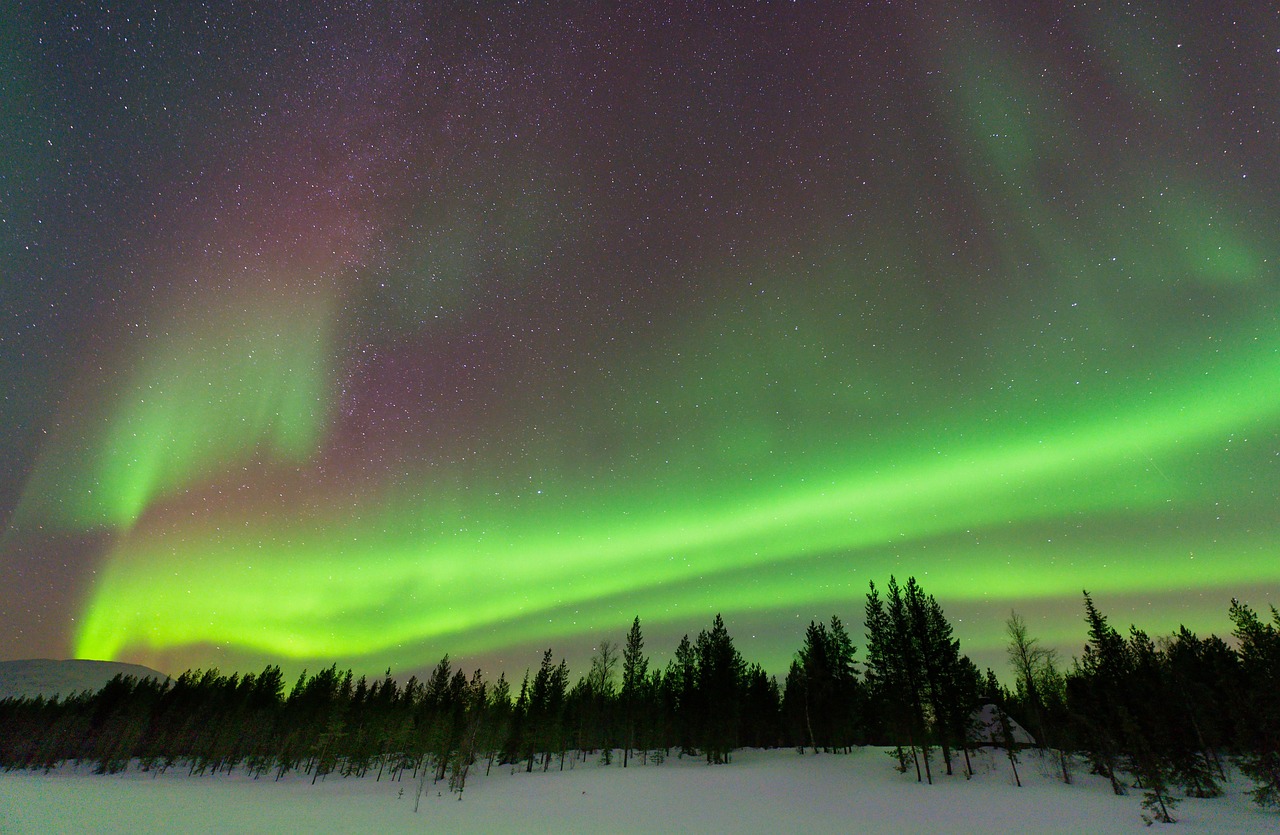
A night under a glass dome costs 250 to 450 € out of season and 900 to 2,000 € in Christmas week. It is by far the most expensive accommodation in Lapland.
The question is not whether it looks beautiful. It is what that price buys exactly, and above all what it does not buy. A glass igloo guarantees no northern lights.
This page does two things. First it untangles the three very different products sold under the same word, then it says under exactly which conditions the spend is justified.
Three different rooms sold under the same word
Booking engines file products with neither the same price nor the same experience under "glass igloo". The photos keep the confusion going: a wide angle shot taken from the bed makes a simple glazed section of roof look like a full dome.
| Type | What it actually is | Price per night |
|---|---|---|
| Full glass dome | Walls and roof glazed through 360°, small floor area, sometimes no shower and no Wi-Fi in the entry categories | 250 to 450 € out of season, 400 to 990 € in winter |
| Glass-roofed cabin | Conventional timber build with a glazed section of roof above the bed, a proper bathroom, sometimes a sauna | From 239 to 439 € depending on size |
| Panoramic suite | Apartment with glazed walls and roof on the living side, private sauna, outdoor hot tub, daily housekeeping | 595 to 1,500 € |
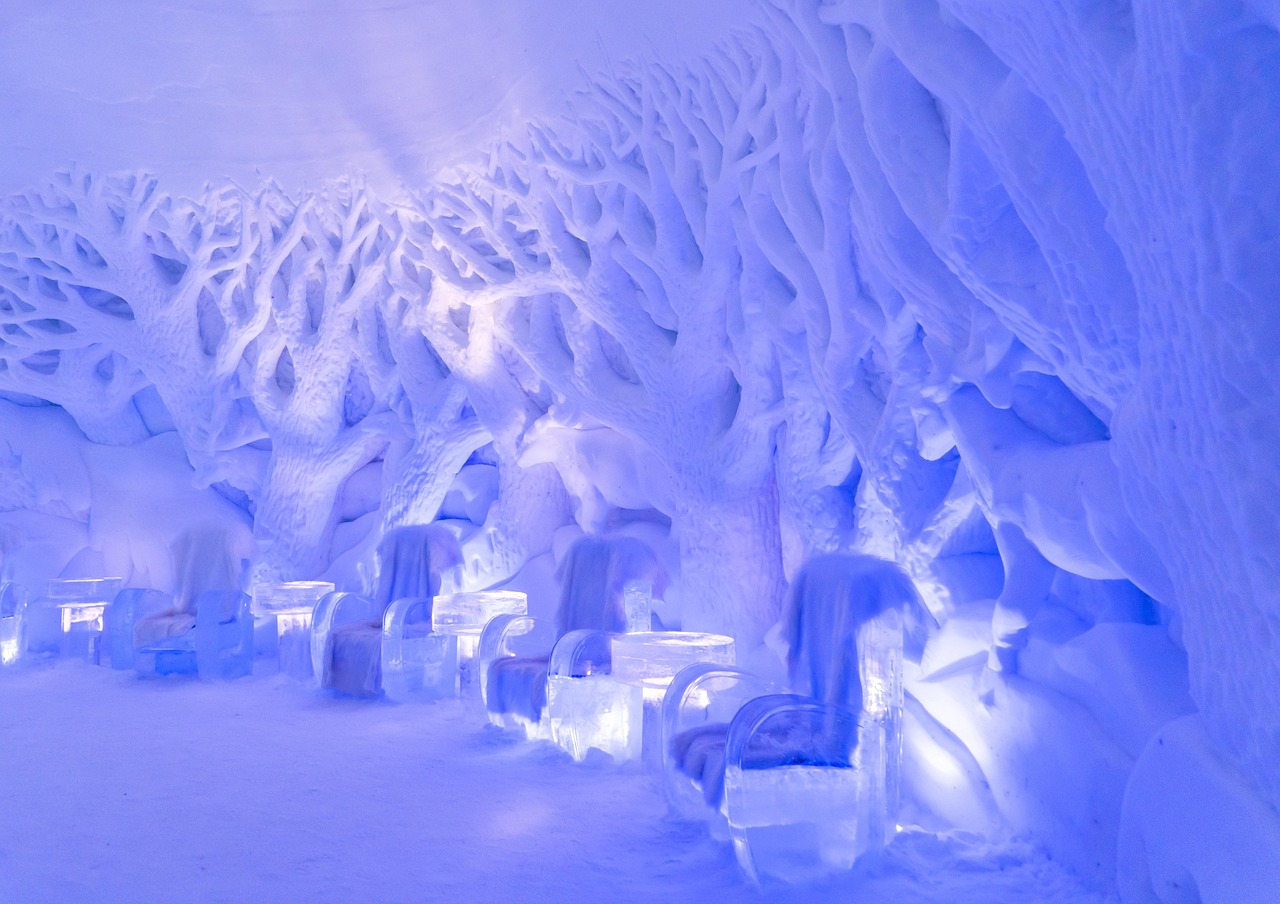
| Snow hotel | No glass at all: a room carved out of the snow, around -5°C, with an arctic sleeping bag | About €299 |
The spread runs from single to sixfold between the top row and the middle one. On booking pages, those four rows often carry the same starry sky imagery.
Here is the counter-intuitive part: the glass-roofed cabin, the least spectacular of the three in a photograph, generally gives you more space, a better bathroom and better sleep than the full dome, for a lower rate.
How much does a night in a glass igloo cost?
The ranges below come from specialist price guides and from rates published by the properties themselves. They are for two people, breakfast generally included.
- Low and shoulder season (September to November, March to early April): 250 to 450 € for a glass dome. A 360° dome with heated glass at Sinettä starts at €314, a glass-roofed cabin at Apukka at €195 in late summer.
- Winter high season (December to February, excluding Christmas): 400 to 990 €. The iconic addresses go above that ceiling, with the small Kakslauttanen igloos recorded at 800 to 1,000 € in January and February.
- Christmas week (roughly 22 December to 2 January): 900 to 2,000 €, which is close to triple the September rate for the same room.
For scale, a conventional city centre hotel in Rovaniemi runs at around 110 to 200 € a night from January to March, and a simple cabin with sauna and kitchenette between 55 to 120 €.
The igloo season runs from late August to late April depending on the property. Outside that window the sky is never dark enough for an aurora anyway.
Why does the glass dome guarantee nothing?
Seeing an aurora from your bed needs three conditions at once: enough geomagnetic activity, a clear sky above you, and being awake at the right moment. The glass supplies none of the three.
The numbers are harsh. A December night offers a 4.5% chance of seeing an aurora in Rovaniemi, against 10% in March. Cloud cover reaches 86% in December.
Put another way, booking a dome at 900 € a night in Christmas week means paying the highest rate of the year for the worst statistics of the year. A night at that price can perfectly well end in a grey ceiling of cloud and nothing else.
The choice of month weighs twice as heavily as the choice of room. Our page on which month to choose for Lapland works through all twelve months on that single criterion.
Does the aurora wake-up service deliver?
Several properties include an "aurora alarm": a night watchman or a sensor picks up the activity and triggers a call to the room. Arctic SnowHotel at Sinettä, Kakslauttanen and Santa's Hotel Aurora at Luosto all advertise it.
It is a real service, and it is also the weak point guests report most often. Travellers describe the alarm failing to go off while an aurora was plainly visible outside, and the opposite happens too.
The system also assumes you accept being woken at three in the morning, several nights running if need be. Plenty of couples discover on arrival that this was not quite the programme they had in mind.
Check before booking whether the alarm is human or automatic, and whether it rings in the room or only arrives as a notification on your phone. The difference is very concrete when you are asleep.
Light pollution at the site itself
This is the part brochure photographs never show. Two of the most heavily sold addresses in Rovaniemi, Glass Resort and Santa's Igloos Arctic Circle, sit inside or right beside Santa Claus Village.
Street lights, illuminated decorations, car parks and traffic: this is not a dark sky reserve. Strong, high auroras stay visible, but weak arcs low on the horizon disappear completely.
Sites further out change the picture. Sinettä is 21 km from Rovaniemi, Ranua 80 km, Luosto 110 km, and the Inari cabins more than 320 km north, under a distinctly darker sky.
So the reasoning goes in this order: the darkness of the site first, the type of glass second. A glass-roofed cabin deep in the forest beats a full dome parked under a street light. Our page on where to watch the auroras around Rovaniemi compares the sectors.
Which way does your glass roof face?
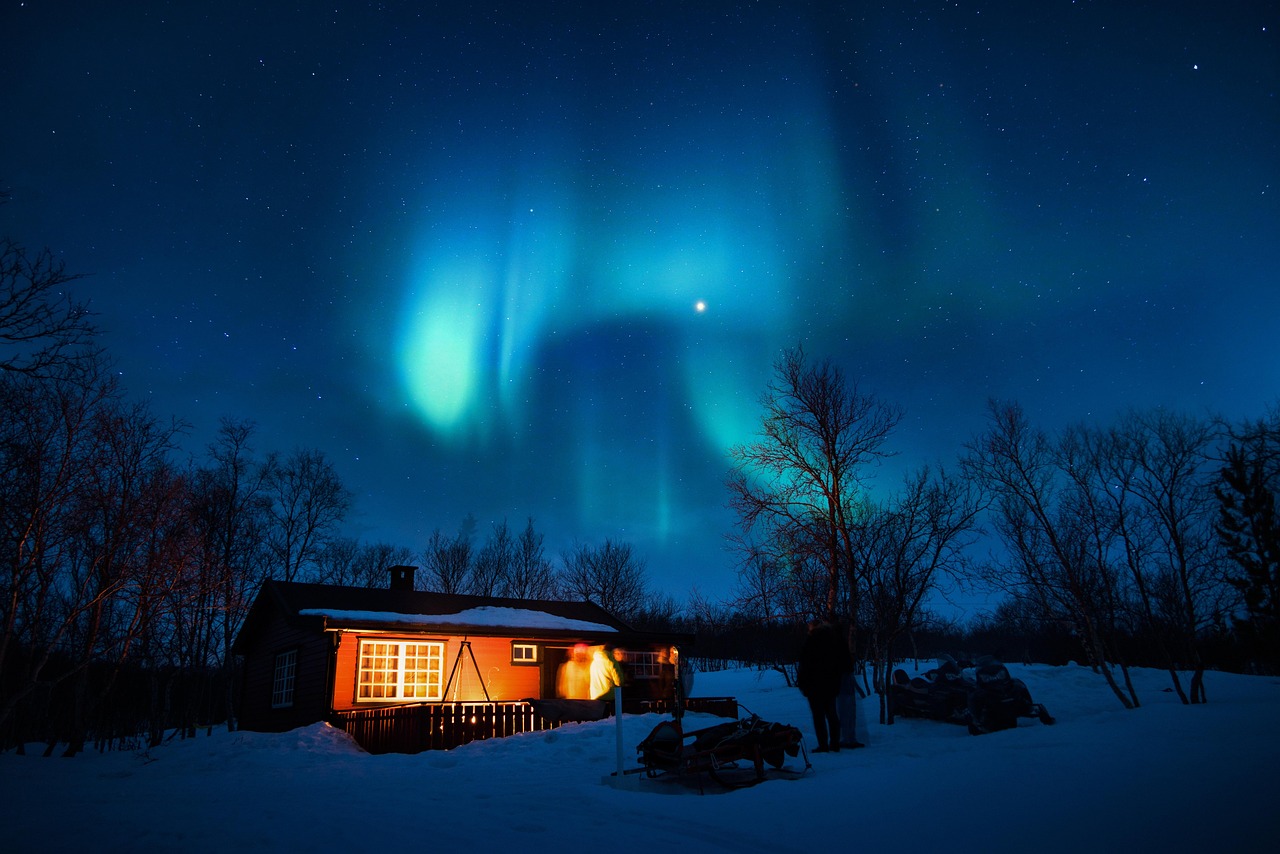
A question rarely asked, and yet decisive. An aurora most often appears to the north, sometimes fairly low on the horizon before it climbs. A glazed roof only shows you the zenith.
In practice, a cabin whose glazed front faces north over a frozen lake gives you a better read on the sky than a dome ringed by spruce, even a 360° one. The tree line cuts out exactly the portion of sky that matters.
Three questions to ask by email before you pay: is the glazed opening above the bed or in the front wall, which way does it face, and what is in front of it, forest, lake or other cabins.
Heating and condensation: the subject nobody raises
Cold glass in a heated room mists up, then frosts over. That is elementary physics, and it is the fault most regularly flagged in guest reports on glass domes.
Serious properties answer it with heated glass, sometimes with heating wires built into the roof. Arctic SnowHotel at Sinettä and Northern Lights Village at Levi both make a point of it, which is not a throwaway marketing line.
Where there is none, the view blurs after a few hours and the aurora becomes a diffuse green smudge. Travellers also report uneven heat and limited sound insulation under the domes.
The question to ask is therefore: is the glass heated, across the whole surface or only part of it. A property that cannot answer probably does not have the right answer.
The strategy that makes an igloo night pay off
It fits in one sentence: a single night under the dome, slotted into a longer trip in conventional accommodation, and at a time of year when the aurora probability is decent.
The arithmetic is easy to check. Five nights in a dome in high season come to 2,000 to 4,950 €. Four hotel nights in town plus one igloo night come to 840 to 1,790 €, for the same number of nights under the Lapland sky.
The difference, between 1,000 and 3,000 €, comfortably funds several guided aurora hunts at 59 to 150 € per person, some snow activities, and there is still margin left. More nights and more outings raise your chances, the glass dome does not.
As for the month, March or February beat December on every criterion that matters here. Our estimate of what a trip really costs lays out the full trade-off between accommodation, transport and activities.
The combination that works: the rest of the trip in conventional accommodation in Rovaniemi, at three to five times less than the dome, and the money saved put into guided outings. It is the only reliable way to see an aurora on the nights your igloo gives you nothing: the guides track the cloud cover in real time and move to another spot during the evening, which a fixed glass roof will never do.
See the aurora hunts →Affiliate links: booking through them supports the site at no extra cost to you.Do you need to book a year ahead?
For Christmas and New Year, yes: the specialist guides recommend 8 to 12 months ahead, most addresses being full for the 22 December to 2 January window by the previous September.
For January and February, allow 4 to 9 months ahead, the top of that range applying to small, heavily demanded properties. In March and in the shoulder season the pressure drops sharply.
Watch out for the trap that breaks the single night strategy: many properties impose a minimum stay in winter. Apukka Resort, for instance, requires 3 nights from 1 December to early January.
Check this point before anything else. If the minimum is three nights the trade-off changes completely, and it is often better to aim at another property or shift by a month.
Is a glass igloo worth the price?
Yes, on three conditions that all have to hold, and no if one is missing. The site has to be genuinely dark, the glazed opening well oriented and heated, and the night has to fall in a month with a decent aurora probability.
No if what you are buying is a probability. The igloo does not sell you a chance of seeing an aurora, it sells you a setting to watch one from if it comes. Those are two different products, and only one of them is being charged for.
No, equally, if the igloo eats the entire budget for the trip. A full week under the dome costs as much as the flight, the accommodation and all the activities put together, for an experience that runs out of novelty by the second night.
To go further, read our guide on how to see the northern lights in Lapland, which deals with the phenomenon itself rather than the room you watch it from.
Sources
Laplandtripplanner, Lapland price guides and glass igloo comparison, 2024 to 2026 editions. Glass-igloos.com for the property listings and the 2026-2027 price guide. Official terms and FAQ from Apukka Resort (2024 and 2026) and the official site of Northern Lights Village Levi (2025).
Finland-Holiday for the survey of properties around Rovaniemi. Field reports published by findingtheuniverse, pickyourtrail, dangerous-business, meganstarr and travelherstory on condensation, the aurora alarm and light pollution. Finnish Meteorological Institute and the WeatherAway model for aurora probabilities and cloud cover. Data verified in August 2026.
Frequently asked questions
Can you really see the northern lights from your bed in a glass igloo?
How much does a night in a glass igloo in Lapland cost?
What is the difference between a glass igloo and a glass-roofed cabin?
How far ahead do you need to book a glass igloo?
Can you book a single night in an igloo?
Does the glass in the igloos not mist up?
Is it better to sleep in an igloo or take a guided aurora hunt?

Camille Rousset
Camille has covered Nordic destinations for ten years. She checks every price and every opening time at the source, and refuses to publish a figure she cannot date.